
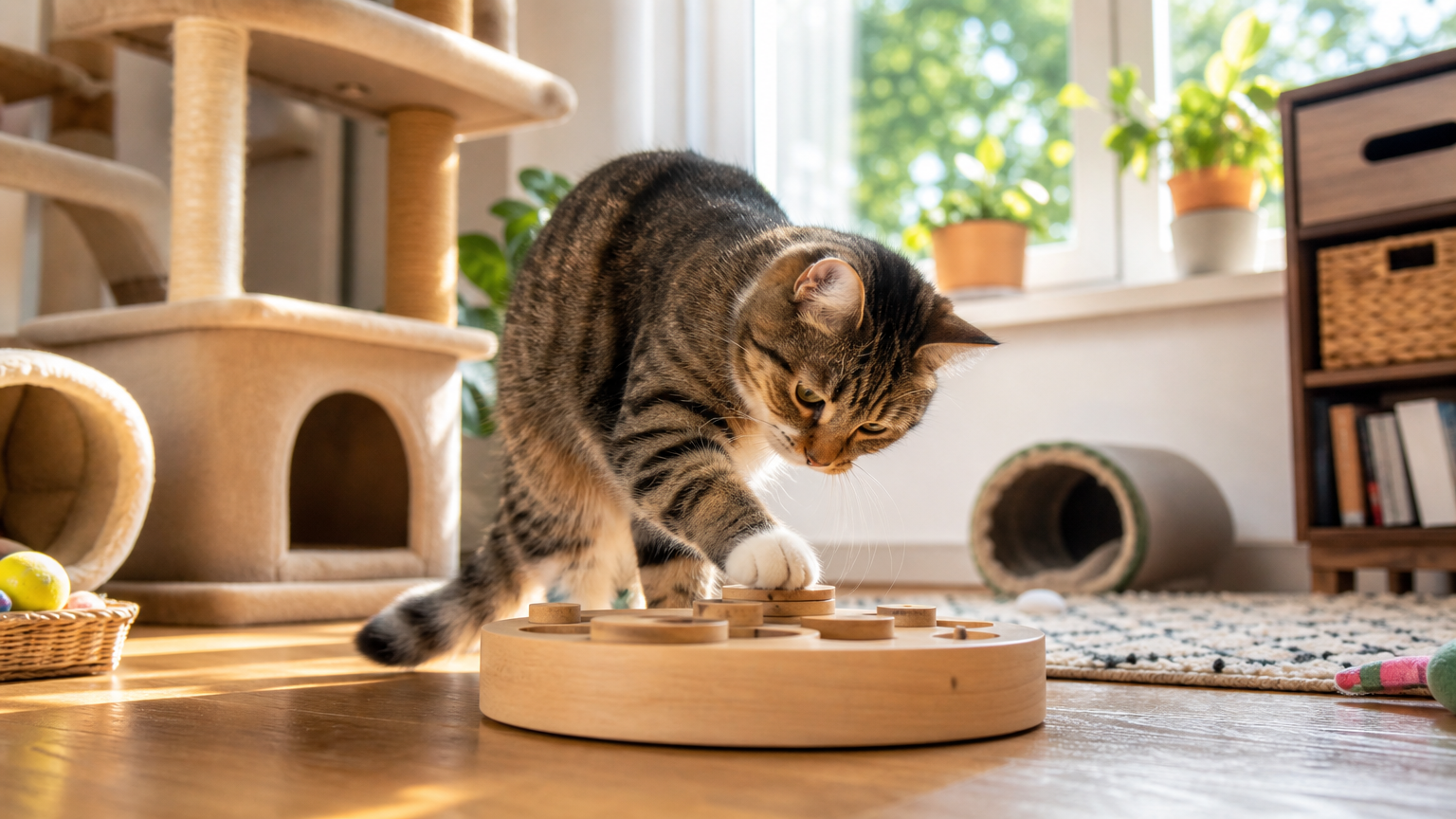
Is your cat bored, destructive, or gaining weight? As a veterinarian, I share the best cat enrichment ideas — from puzzle feeders to vertical spaces — to keep your feline physically and mentally stimulated.
As a veterinarian, one of the most common misconceptions I hear is that cats are “low-maintenance” pets. The truth is, cats have complex behavioral needs that are often overlooked simply because they don’t destroy the house like dogs do when those needs aren’t met.
Instead, an under-stimulated cat develops subtle but serious problems: obesity, excessive grooming, litter box avoidance, aggression toward other pets, or that frustrating 3 AM zoomie session.
The solution is environmental enrichment — and it’s not just about buying more toys. It’s about creating an environment that allows your cat to express their natural behaviors: hunting, climbing, scratching, exploring, and hiding.
In this guide, I’ll walk you through the five pillars of feline enrichment and practical ideas you can implement today.
🟢 Why Enrichment Matters — From a Veterinary Perspective
Cats evolved as solitary hunters. In the wild, a cat spends 50–70% of their waking hours hunting and foraging for food. An indoor cat, on the other hand, gets their meals served in a bowl twice a day — with zero effort.
This mismatch between instinct and environment is the root cause of most behavioral problems I see in my clinic.
Obesity — Lack of hunting/foraging activity
Destructive scratching — No appropriate scratching surfaces
Aggression — Frustration from unmet predatory needs
Litter box issues — Stress from inadequate territory
Excessive grooming — Boredom or chronic stress
Night-time activityInadequate daytime stimulation
👉 The good news: Most of these problems improve dramatically with proper enrichment — often without medication.
🟡 The Five Pillars of Feline Enrichment
🧩 Food-Based Enrichment
This is the single most impactful change you can make. Instead of feeding from a bowl, make your cat work for their food.
Ideas you can start today:
- Puzzle feeders — Food-dispensing balls, maze bowls, or commercial puzzle toys
- Snuffle mats — Hide kibble in a mat for foraging
- Food scatter — Simply scatter kibble across the floor or in a cardboard box with crumpled paper
- Treat tubes — Fill a treat tube or lick mat with wet food and freeze it
- Training sessions — Yes, cats can learn tricks! Use kibble as rewards for “sit,” “high five,” or “touch”
How much time to add: Replacing one bowl meal per day with a foraging activity adds 15–30 minutes of mental stimulation — equivalent to a good workout for your cat’s brain.
2. 🏔️ Vertical Space
Cats are vertical animals. In the wild, they escape danger and survey their territory from high places. Indoor cats need the same opportunity.
What to add:
- Cat trees — At least 5–6 feet tall, with multiple perches
- Wall shelves — Cat-specific wall-mounted shelves create a “cat highway”
- Window perches — A simple suction-cup hammock by a window provides hours of entertainment
- Cat condos — Multi-level structures with hiding spots
The rule of thumb: Your cat should be able to move from one end of your home to the other without ever touching the floor — using cat trees, shelves, and furniture.
3. 🐾 Scratching Outlets
Scratching is not destructive behavior — it’s essential for claw health, scent marking, and stretching. Your cat needs to scratch. Your job is to redirect it to appropriate surfaces.
The right scratchers:
- Material matters — Most cats prefer sisal rope, cardboard, or carpet. Offer all three
- Position matters — Place scratchers near where your cat sleeps and near entry points (doors, windows)
- Angle matters — Some cats prefer horizontal, others vertical. Offer both
- Quantity matters — One scratcher per cat, plus one extra, distributed through the home
4. 🧠 Mental Stimulation and Play
Cats need to hunt — even if it’s just a toy. The key is mimicking the prey sequence: stalk, chase, pounce, catch, and “kill.”
Effective play strategies:
- Interactive wand toys — Move them like prey (erratic, hiding, fast then slow)
- End the hunt — Let your cat catch the toy at the end of each session, then give a small treat (this completes the hunt-kill-eat cycle)
- Rotate toys — Cats get bored. Rotate toys weekly to keep them “new”
- Hide and seek — Hide toys or treats around the house for your cat to find
- Catnip and silvervine — Offer catnip-stuffed toys or silvervine sticks for solo play
How much playtime? Two 10–15 minute sessions per day — ideally one in the morning and one before bed — significantly reduce unwanted behaviors.
5. 🏠 Safe Hiding and Resting Spaces
Cats are both predator and prey. They need safe zones where they can retreat and observe without being approached.
Ideas:
- Covered beds — Igloo-style beds or boxes with a blanket over them
- Cat caves — Commercial cat caves or simple cardboard boxes with a hole cut out
- High perches — Elevated spots where the cat can see the room but not be reached
- Quiet rooms — A room with a litter box, water, and bed where the cat can be undisturbed
🔴 Enrichment for Multi-Cat Households
If you have more than one cat, enrichment becomes even more critical. Without it, competition for resources leads to stress and conflict.
Key principles:
- One resource per cat, plus one extra — Litter boxes, food bowls, water fountains, beds, scratchers
- Separate feeding stations — Feed cats in different areas to prevent food aggression
- Multiple vertical escape routes — Each cat needs a way to avoid the other without being trapped
- Individual play sessions — Each cat should have solo playtime with you
🟠 DIY Enrichment on a Budget
You don’t need expensive equipment. Some of the best enrichment is free or nearly free:
- Cardboard boxes — Cut holes, connect boxes, create a “fort”
- Paper bags — Remove handles first, let your cat explore
- Toilet paper rolls — Hide treats inside and fold the ends
- Ice cubes — Drop one or two on a hard floor for batting fun
- Sink drips — Some cats love playing with a slow drip of water
- Window bird watching — Set up a cozy spot by a window with bird activity
🟣 When Enrichment Isn’t Enough — When to See Your Veterinarian
Enrichment solves most behavioral issues, but not all. Schedule a checkup if:
- Your cat is hiding more than usual or avoiding interaction
- There’s a sudden change in appetite, litter box habits, or activity level
- Your cat is over-grooming to the point of bald patches or skin sores
- You’ve tried enrichment consistently for 4–6 weeks with no improvement
- There’s aggression toward people or other pets that seems unprovoked
Medical issues — arthritis, dental disease, hyperthyroidism, or urinary tract infections — can all mimic behavioral problems. Always rule out pain first.
❓ Frequently Asked Questions
How much enrichment does my cat need daily? At minimum: one 10–15 minute interactive play session, one food-based enrichment activity (puzzle feeder or scatter feeding), and access to vertical space and scratching surfaces.
My cat ignores all toys. What do I do? Try different textures and movement styles. Some cats prefer toys that mimic birds (feathers, erratic movement), others prefer mice (fur, ground-level dragging). Also try silvervine — some cats that don’t respond to catnip respond to silvervine.
Is it too late to enrich a senior cat? Never. Senior cats benefit greatly from gentle enrichment — low puzzle feeders, soft wand toys, heated beds, and easy-to-reach perches. Adjust intensity to their mobility level.
Can I have too much enrichment? Yes, if it causes stress. Some cats are overwhelmed by too many changes at once. Introduce one new enrichment item at a time and let your cat approach it at their own pace.
Does my outdoor cat need enrichment? Yes. Outdoor cats still benefit from food puzzles, scratching posts, and interactive play. Enrichment isn’t just for indoor cats — it strengthens your bond regardless of lifestyle.
Final Thoughts
As a veterinarian, I tell my clients this: a well-enriched cat is a healthy cat. Enrichment prevents more problems than any vaccine or medication ever could — obesity, stress, behavioral issues, and even some urinary tract conditions.
You don’t need to do everything at once. Pick one idea from this list and try it today. A puzzle feeder. A cardboard box. Five minutes with a wand toy. Your cat will thank you — and so will your furniture, your sleep schedule, and your vet bill.