
Best Dog Food for Allergies: A Veterinarian’s Complete Guide to Hypoallergenic Diets
As a veterinarian, I explain how to choose the best dog food for allergies — limited ingredient, novel protein, and hydrolyzed diets — plus how to run a proper elimination trial.
As a veterinarian, I hear the same question constantly: “My dog is itchy all the time — what’s the best food for allergies?”
And here’s the honest answer: there is no single “best” dog food for allergies. The right food depends entirely on what your dog is allergic to — and that’s exactly what most owners get wrong.
Food allergies in dogs are a true immune reaction to a specific ingredient, most commonly a protein. But “allergy-friendly” marketing has created a confusing landscape: limited ingredient, novel protein, hydrolyzed, grain-free, hypoallergenic — these terms get thrown around as if they’re the same thing. They’re not.
In this guide, I’ll explain what actually matters when choosing food for an allergic dog, the different types of allergy diets, and how to work with your veterinarian to find the right one.
🟢 First: Is It Really a Food Allergy?
Before changing your dog’s food, it’s critical to understand that food allergies are less common than most owners think. According to veterinary research, only about 1–2% of dogs have true food allergies.
The signs of a food allergy include:
- Itching (especially paws, face, ears, belly)
- Recurring ear infections
- Skin infections
- Vomiting or diarrhea
- Chronic gas
But here’s the catch: these same signs can be caused by environmental allergies, flea allergies, or skin infections. That’s why many dogs are put on a new food, don’t improve, and the owner assumes “it didn’t work” — when the real issue was never food.
👉 Rule of thumb: Before you change the food, rule out fleas, mites, and environmental allergens with your veterinarian.
🟡 The Three Types of Allergy Diets
If your veterinarian suspects a food allergy, they’ll recommend one of these approaches:
1. Hydrolyzed Protein Diets
What it is: Proteins are broken down (hydrolyzed) into fragments too small to trigger an immune reaction.
Best for: Severe allergies, elimination trials, dogs that seem allergic to everything.
Examples: Royal Canin Veterinary Diet Hydrolyzed Protein, Hill’s Prescription Diet z/d.
Pros:
- Safest choice for elimination trials
- Scientifically proven to prevent immune reactions
- Complete and balanced
Cons:
- Prescription only
- Expensive
- Some dogs dislike the taste
2. Novel Protein Diets
What it is: Uses a protein source your dog has never eaten before — venison, rabbit, duck, kangaroo, or even alligator.
Best for: Dogs with suspected allergies to common proteins (chicken, beef, dairy).
Examples: Limited ingredient diets with rabbit, venison, duck, or salmon.
Pros:
- Often available without prescription
- More palatable than hydrolyzed diets
- Can be used long-term
Cons:
- Your dog must never have eaten the protein before
- Cross-contamination risk in manufacturing
- Your dog may eventually develop an allergy to it too
3. Limited Ingredient Diets (LID)
What it is: Contains fewer ingredients — typically one protein and one or two carbohydrate sources.
Best for: Mild sensitivities, maintenance after identifying the trigger.
Examples: Limited ingredient formulas with salmon, turkey, or lamb plus potato, sweet potato, or peas.
Pros:
- More affordable
- Widely available
- Easier to identify triggers
Cons:
- Not truly “hypoallergenic” — can still contain allergens
- Less controlled than hydrolyzed diets
- Some are grain-free, which has its own risks
🔴 What About Grain-Free Diets?
This is where I see the most confusion — and the most harm.
Grain-free does NOT mean hypoallergenic. In fact, food allergies in dogs are almost always to proteins (chicken, beef, dairy, eggs), not grains. The percentage of dogs actually allergic to grains is very small.
Even worse: grain-free diets have been linked to dilated cardiomyopathy (DCM), a serious heart condition, in some dogs. The FDA has investigated this link since 2018, and veterinary cardiologists now warn against grain-free diets unless specifically recommended.
👉 My recommendation: Don’t choose grain-free for allergies. If your dog has a confirmed grain allergy (rare), work with your vet — but for most dogs, grain-inclusive allergy diets are safer and equally effective.
🟠 The Elimination Trial: The Gold Standard
This is the only reliable way to diagnose a food allergy — and it’s where most owners fail.
How It Works
- Choose the diet — hydrolyzed or novel protein, recommended by your vet
- Feed ONLY that food for 8–12 weeks
- No exceptions — no treats, no table scraps, no flavored medications, no chew toys with flavoring
- Observe — if symptoms improve, food allergy is likely
- Challenge — reintroduce the old food to confirm; if symptoms return, the diagnosis is confirmed
Why Most Owners Fail
- They give in to the puppy eyes and offer treats
- They stop too early (improvement takes 4–8+ weeks)
- They forget that flavored heartworm/flea medications count as food
- They switch between multiple foods instead of sticking to one
🔑 Key insight: An elimination trial is only as good as your discipline. One treat can ruin 8 weeks of trial.
🟡 How to Choose the Right Food (Step by Step)
- See your veterinarian first — rule out fleas, mites, and infections before changing food
- Run a proper elimination trial — 8–12 weeks, strict, no cheating
- Choose the diet based on the trial — hydrolyzed or novel protein
- Read labels carefully — check for hidden proteins, “natural flavors,” and cross-contamination
- Consider the AAFCO statement — ensure the food is complete and balanced
- Transition slowly — mix old and new food over 7–10 days to avoid digestive upset
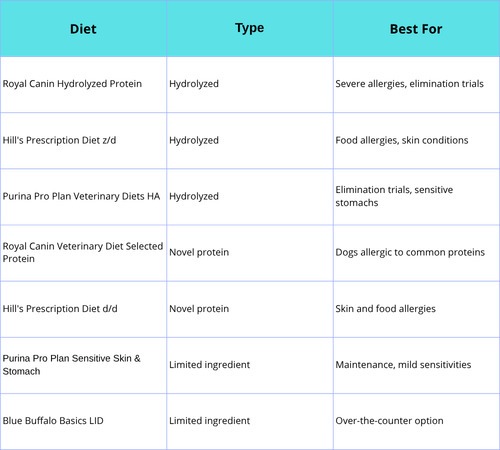
🔵 Top Vet-Recommended Allergy Diets (2026)
These are the brands veterinarians most commonly recommend, based on research and clinical experience:
🟣 Common Mistakes to Avoid

❓ Frequently Asked Questions
How long does a food elimination trial take? 8–12 weeks minimum. Most dogs show improvement within 4–8 weeks if food is the cause, but the full trial is needed for a reliable diagnosis.
Can my dog be allergic to chicken? Yes. Chicken and beef are the most common food allergens in dogs. Dairy, eggs, wheat, and soy follow.
Is expensive food always better for allergies? No. The best food is the one that works for your dog — not the most expensive one. Prescription hydrolyzed diets are the most scientifically reliable, but some dogs do well on novel protein diets.
Can allergies develop suddenly in adult dogs? Yes. Dogs can develop food allergies at any age, even after years on the same food. The immune system can become sensitized over time.
Do I need to feed allergy food forever? For true food allergies, yes — usually for life. Once the offending protein is identified, your dog must avoid it permanently.
Final Thoughts
As a veterinarian, my strongest advice is this: don’t guess with food allergies. The wrong guess means weeks or months of continued suffering for your dog — and a lot of wasted money for you.
Work with your veterinarian. Run a proper elimination trial. Choose the diet based on evidence, not marketing.
The right food won’t just stop the scratching — it can transform your dog’s quality of life.