
How to Stop a Dog From Barking: 7 Effective Techniques
Your dog barks at the gate, at the neighbor, at the wind — and you’ve run out of ideas. Barking is the most natural way dogs communicate, but when it becomes constant, it stops being just the pet’s problem: it becomes stress at home and friction with the neighborhood.
The good news? You can teach your dog to bark less — without shouting, without punishment, and without shock collars. The science of canine behavior is clear: techniques based on positive reinforcement and desensitization work, and results come faster than you might think.
In this article, you’ll discover 7 effective techniques to stop a dog from barking and understand which one fits your dog’s profile.

Why Does the Dog Bark? Understand Before You Act
Before applying any technique, it’s essential to answer one question: why is your dog barking? Barking is a symptom — and each cause requires a different approach.
The most common causes:
- Alarm and protection — the dog barks to alert about something “different” in the territory
- Boredom and excess energy — dogs without stimulation bark to burn energy
- Separation anxiety — barking when you leave home
- Fear — noises, strangers, or situations that scare them
- Attention — the dog learned that barking makes you look at him
- Greeting — excitement when someone arrives
Identifying the trigger is the first step to knowing how to stop a dog from barking in your specific case. A dog that barks out of boredom needs more exercise; a dog that barks out of fear needs desensitization. Treating the wrong cause is a recipe for frustration.
See, you might also enjoy reading: Alternative Proteins for Dogs With Allergies: 7 Options
How to Stop a Dog From Barking: 7 Effective Techniques
1. Positive Reinforcement: Reward the Silence
The technique most recommended by vets and trainers is positive reinforcement. The idea is simple: reward the behavior you want to see more often.
In practice: when the dog stops barking on his own, even for a few seconds, say “quiet” and offer a treat. Over time, he associates the word with calm behavior — and with the prize. Studies and animal behavior experts agree: positive reinforcement educates without fear and without side effects.
2. Desensitization: Get the Dog Used to the Trigger
If the dog barks at the gate, the doorbell, or other dogs, desensitization is the right technique. It involves exposing the dog to the stimulus in small doses, increasing gradually.
Practical example: if he barks at the doorbell, record the sound and play it at a very low volume. Reward calmness. Raise the volume slowly, session after session. The dog learns the sound isn’t a threat — and stops reacting.
3. Counterconditioning: Swap the Negative Emotion for a Positive One
Often, barking comes from a negative emotion (fear, excessive excitement). Counterconditioning swaps that emotion for a positive one: every time the trigger appears, the dog gets something wonderful.
Does the dog bark at visitors? Ask a friend to arrive and, the moment they appear, toss high-value treats. With repetition, the dog learns to associate visitors with good things — and the barking loses its purpose.
4. Teach the “Quiet” Command
The “quiet” command is a practical everyday tool. The training:
- Wait for the dog to bark.
- Say “quiet” calmly and firmly.
- The instant he stops (even for 1 second), reward immediately.
- Repeat, gradually increasing the required quiet time.
The secret is timing: the reward must come at the exact moment of silence, so the dog understands what’s being rewarded.
5. Increase Physical and Mental Exercise
Many barks are actually pent-up energy. A tired dog has less motivation to bark. Make sure to provide:
- Daily walks with duration appropriate to breed and age
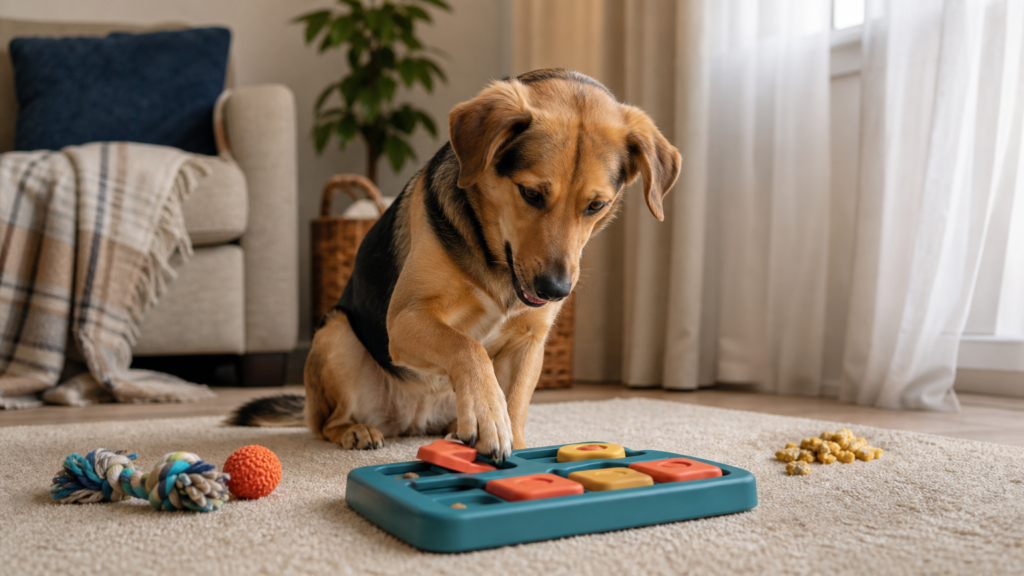
- Interactive toys and treat-dispensing puzzles
- Short obedience training sessions (5 to 10 minutes a day)
- A predictable daily routine
Mental stimulation matters as much as physical: bored dogs bark; stimulated dogs rest.
6. Avoid Accidentally Reinforcing the Barking
This is the most common mistake — and the most silent one. If the dog barks and you yell “shut up,” to him that can be attention (exactly what he wanted). If he barks to go out and you open the door, he learned that barking works.
The golden rule: never reward barking with attention, food, or open doors. Wait for silence — even if it lasts seconds — and only then give him what he wants. Intermittent reinforcement (sometimes yes, sometimes no) is what strengthens behavior most; consistency is what weakens it.
7. Manage the Environment and the Triggers
While training isn’t consolidated yet, manage the scene to reduce opportunities to bark:
- Close curtains if the dog barks at people passing by
- Use calm music or white noise to mask outside sounds
- Keep toys available during high-stimulation times
- In separation anxiety cases, work on gradual departures (see our full plan in our article on the topic)
See, you might also enjoy reading: Probiotic Dog Food: What’s Myth and What’s True
What NOT to Do When Trying to Stop a Dog From Barking
Some popular “solutions” are ineffective — and even harmful:
- ❌ Yelling at the dog — can increase excitement and be read as “barking along”
- ❌ Shock or spray collars — cause fear and can trigger aggression; veterinary associations advise against them
- ❌ Hitting or physically punishing — destroys the bond and worsens anxiety
- ❌ Ignoring completely — if the barking has a real cause (fear, pain), ignoring won’t solve it
- ❌ Debarking surgery — invasive, banned in several countries, and doesn’t treat the cause
Remember: barking is communication. The goal isn’t a mute dog — it’s a dog that knows when to bark and when to stay calm.
When to Seek Professional Help
If you’ve applied the techniques for a few weeks and the barking remains intense, seek a veterinarian specializing in behavior (clinical ethology) or a trainer trained in positive reinforcement. Cases of anxiety, extreme fear, or persistent nighttime barking may require professional support — and sometimes veterinary-prescribed medication.
Conclusion: How to Stop a Dog From Barking With Patience and Consistency
Stopping a dog from barking isn’t about miracles — it’s about method. Understanding the cause, applying positive reinforcement, desensitizing triggers, and staying consistent are the pillars of any lasting change.
No technique works overnight. But with patience, you’ll see excessive barking decrease week after week — and you’ll get your peace back without sacrificing your bond with your dog.
Start today: identify the main barking trigger and apply technique #1 (positive reinforcement) the next time he barks. Today’s consistency is tomorrow’s silence.